How global media fell for an AI-generated Thai police drag hoax..


It had all the ingredients of a viral, feel-good internet sensation: four middle-aged Thai police officers, allegedly sacrificing their dignity for the sake of justice, squeeze into extravagant, shimmering carnival drag to blend into a local festival. Their target? A notorious local meth dealer. The payout? A hilarious mugshot featuring the stone-faced 'undercover' officers posing alongside a beautiful dancer and their newly apprehended suspect.
International newsrooms bit the bait hard. Outlets ranging from the New York Post and the Daily Telegraph to Bored Panda rushed out articles celebrating the tactical brilliance and comedic value of Thailand’s finest.
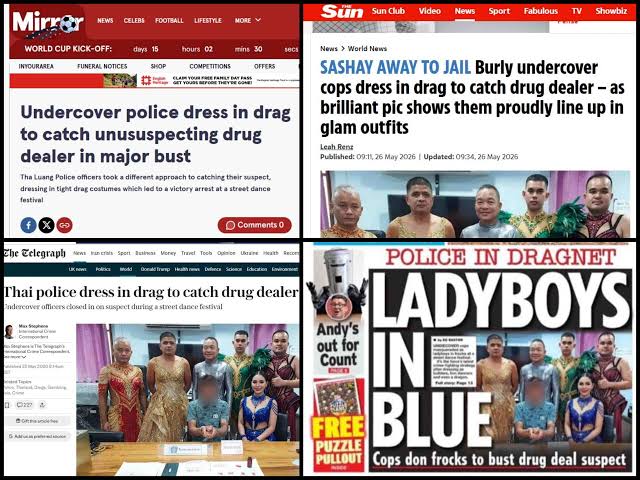
There was only one glaring issue: it never happened. The story was entirely fictional, the 'suspect' bore a nonsensical joke name, and the spectacular image was the product of generative Artificial Intelligence.
The viral whirlwind began when the official Facebook page of the Tha Luang District Police Station in Lopburi province, central Thailand, uploaded the image. Accompanying the photo was a humorous caption claiming officers went deep undercover at a local carnival to capture a dealer named 'Mekha Fahwapwap'—a name that translates roughly to a crude, juvenile Thai pun about fast-moving clouds (or rather, fast-moving hands).
The post immediately caught the eye of English-language media inside Thailand before being propelled onto the global stage.
When the dust settled and local journalists actually picked up the phone, the truth came out. Police Colonel Panthep Panadit, the superintendent of the Tha Luang station, openly admitted the entire thing was an unverified publicity stunt born out of an automated mix-up.
'The image showing police officers wearing drag-style costumes while arresting the suspect was created using AI software,' Colonel Panadit confirmed. 'As for why they were wearing that, I honestly don’t know either. I wasn’t the one who posted it. Someone sent it to me to have a look at.'

According to the superintendent, the station's Facebook page admin didn't intentionally prompt the AI to dress the force in drag. "The algorithm simply generated the image in that style on its own," he claimed. "It seems that kind of style attracts the most attention, so the system did it that way."
While a routine, plainclothes drug arrest had actually taken place in the district, there were no elaborate costumes, no carnival, and absolutely no undercover drag queens.
Why did seasoned international journalists - including self-proclaimed 'International Crime Correspondents' - publish the story without a second thought?
Part of the blame lies in recent history. Just a short while prior, Thai police made global headlines for a bizarre, yet entirely real, undercover sting operation. In that legitimate case, officers genuinely wore oversized, fluffy Chinese lion dance costumes to stake out and successfully arrest a suspect. Because reality had already proven itself stranger than fiction, newsrooms were primed to believe that Thai law enforcement deploying extravagant costumes was standard operational procedure.
However, a basic application of media literacy and critical thinking should have stopped the drag story from ever hitting a printing press.
The rapid, unchecked syndication of the Tha Luang police station's Facebook post highlights a growing and dangerous vulnerability in modern journalism: the 'too good to check' syndrome. In the race for viral traffic and high-engagement clicks, the fundamental baseline of journalism—verifying the source, checking the facts, and applying basic scepticism—was entirely bypassed.
If major global publications cannot be trusted to verify a patently absurd photo of police officers in drag, how can they be trusted to accurately report on complex international conflicts, geopolitical crises, or economic data?
As AI generation software becomes increasingly sophisticated, the line between reality and digital fabrication will only continue to blur. The Lopburi drag hoax serves as a stark, embarrassing reminder for the mainstream media: if you don't start asking the most basic questions, the algorithm will keep making a fool out of you.
Be careful what you believe online.

Experienced news editor with a strong background in editorial planning, content review, headline writing, and fact-checking. Skilled in managing news coverage, ensuring accuracy, maintaining editorial standards, and delivering timely, engaging stories across digital platforms.
All Rights Reserved © 2026